By stacking thin layers of different materials on top of each other a structural coupling between the layers can be achieved. This coupling can create new and interesting electronic behaviors.
One such behavior, predicted by theory, is a special type of insulating state known as the “Chern insulating phase.” However, this state depends on the material having a perfect cube-like structure.
In reality, the materials often have slight distortions that disrupt this perfect structure, making it harder for the Chern insulating phase to appear. These distortions, known as Jahn-Teller distortions, change how the atoms are arranged and affect the material’s properties.
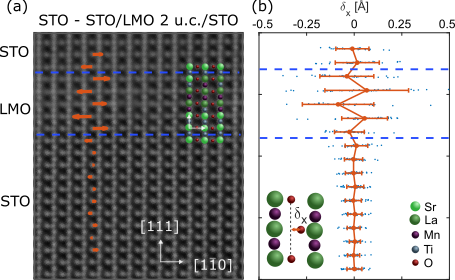
In this study, we looked at thin layers of a material called LaMnO3, grown on different types of surfaces (LaAlO3, SrTiO3, and DyScO3) using a technique called pulsed laser deposition. Using advanced microscopy, we confirmed the structure of these layers and noticed distortions in some cases. We found that the extent of these distortions depends on the type of surface the material is grown on and the strain it experiences.
In simpler terms, this research helps us understand how small changes in the structure of these materials can influence their electronic behavior, which could be useful for designing new electronic devices.
The publication of this work can be found here: https://doi.org/10.1103/PhysRevMaterials.8.125002